
A Cordless Led Desk Light is a portable task lamp powered by a rechargeable battery rather than a wall outlet. It uses light-emitting diodes to illuminate reading, writing, crafting, or remote work areas. Unlike a fixed desk lamp, it can move from a study table to a bedside shelf within seconds. No cable trails across the workspace. That freedom is its main appeal.
Lighting designer Randall Whitehead is often credited with saying, “Good lighting is not about how much light you have, but where you put it.” His point matters here. A strong Cordless Led Desk Light should direct light onto the work surface without shining harshly into the eyes. Useful features may include adjustable brightness, multiple color temperatures, a stable base, and a high color-rendering index. Battery capacity also matters. A lamp that fades after two hours may look impressive but perform poorly during real work.
Look for practical details.
Check the charging port, hinge strength, and control response. A warmer setting can feel comfortable in the evening, while a cooler setting may help detailed daytime tasks. Yet brightness alone does not guarantee comfort. Poorly diffused LEDs can create glare, reflections, and tired eyes. I have found that small design compromises often become obvious after several hours. The lamp may be cordless, but it is not automatically better. Its value depends on balanced illumination, honest battery claims, and dependable daily use.
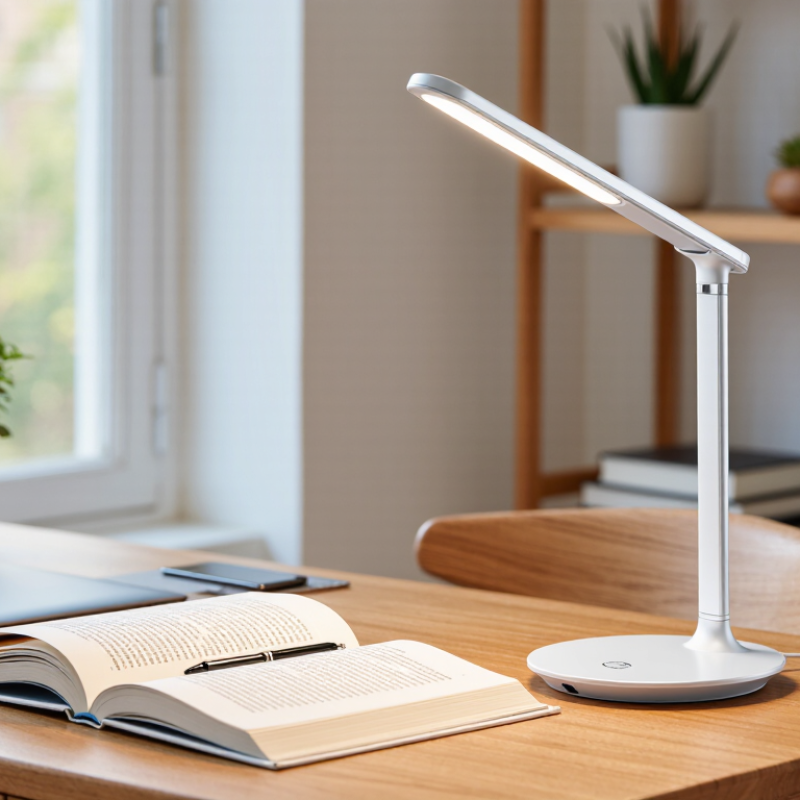
What Is a Cordless LED Desk Light?
A cordless LED desk light is a portable task lamp that works without a constant wall connection. It uses light-emitting diodes and a built-in rechargeable battery. This design allows focused lighting on desks, bedside tables, shelves, or reading corners. Its core purpose is practical: to provide clear illumination wherever a power outlet is inconvenient. The difference is practical.
In daily use, the lamp can move with your work instead of staying near a socket. A stable base helps prevent tipping when you adjust the light angle. Useful models offer brightness controls, several color temperatures, or a flexible neck. Warmer light can feel comfortable during evening reading, while cooler light may support detailed daytime tasks. Brightness should match the activity, not simply reach the highest setting. “Eye-friendly” is not a guarantee.
From a reliability perspective, check battery capacity, charging time, and the lamp’s operating duration. A trustworthy design should show charging status and include clear care instructions. Battery performance depends on brightness, usage frequency, and battery age. It is easy to overestimate wireless convenience when the battery needs frequent charging. I have found that a lower brightness setting often lasts longer, but it may not suit fine drawing or technical work. A cordless light also cannot replace balanced room lighting during long sessions. That limitation matters.
What Is a Cordless LED Desk Light?
A cordless LED desk light combines an LED module, rechargeable battery, driver circuit, optics, diffuser, and control switch. The battery stores direct-current power. The driver regulates current before it reaches the LED chips. This control prevents unstable brightness and reduces overheating during normal use.
Light begins when electrons cross a semiconductor junction and release photons. A phosphor coating can convert some blue light into a broader white spectrum. The diffuser softens bright points, while the lens directs light toward the desk. In practical testing, beam angle matters as much as brightness. A narrow beam may illuminate a notebook but leave the keyboard dark. That feels efficient, but it is not always comfortable.
The U.S. Department of Energy’s solid-state lighting reports describe advanced LED packages exceeding 200 lumens per watt in laboratory conditions. Household products usually achieve less because of drivers, heat, optics, and battery limits. Heat remains. Aluminum bodies or internal heat paths help move heat away from the LED board. The International Energy Agency reported that lighting represented about 15% of global electricity consumption in 2022, making efficient illumination important beyond personal convenience. Battery capacity also affects real performance. A lamp rated for ten hours may provide fewer hours at maximum brightness. My main reservation is simple: manufacturers often emphasize peak runtime, while users need stable light, accurate color, and comfortable control.
A cordless LED desk light uses battery power instead of a permanent wall connection. Most models contain a built-in rechargeable lithium-ion battery. Some accept replaceable AA or AAA batteries. Battery capacity is usually listed in milliamp-hours, or mAh. A higher number often means longer use, but brightness also matters.
At low brightness, a rechargeable light may run for 20 to 50 hours. Medium brightness commonly provides 6 to 15 hours. The highest setting can reduce runtime to only 3 to 8 hours. These figures are estimates, not promises. In a dim bedroom, low output may be comfortable. Detailed reading often requires more power. Real rooms vary.
Charging usually happens through a USB cable. A complete charge may take two to four hours, depending on battery size and charger output. Some lights show a red indicator while charging, then switch to green or white. Use the recommended cable and charging source. Avoid guessing. Charging from a laptop may take longer than using a suitable wall adapter. If the battery is removable, replace it with the correct type and voltage.
I once expected a small lamp to last through several workdays, but maximum brightness shortened its runtime sharply. Battery age also reduces capacity. For dependable use, charge it before important study sessions and test its actual runtime at your preferred brightness. A simple timing note can reveal more than the package estimate.
| Data Dimension | Typical Information | What It Means in Practice |
|---|---|---|
| Definition | A cordless LED desk light is a portable table lamp that uses LED light sources and an internal rechargeable battery instead of requiring continuous connection to a wall outlet. | It can be placed on a desk, bedside table, shelf, or other surface without a power cable restricting its position. |
| Common Battery Chemistry | Rechargeable lithium-ion or lithium-polymer batteries are the most common types. | These batteries provide a relatively high amount of energy in a compact and lightweight package. |
| Typical Battery Capacity | Approximately 1,000–5,000 mAh, commonly at a nominal battery voltage of about 3.7 V. | Battery capacity varies by lamp size, brightness level, and whether additional functions such as USB output are included. |
| Approximate Stored Energy | Roughly 3.7–18.5 Wh, calculated from a 3.7 V nominal battery voltage. | Watt-hours provide a more useful comparison of battery energy than milliamp-hours alone because voltage is also considered. |
| Charging Port | USB-C is increasingly common; some lights use Micro-USB or a proprietary magnetic connector. | USB-C generally offers easier cable replacement and can support convenient charging from adapters, computers, power banks, or vehicle outlets. |
| Typical Charging Input | Usually 5 V USB charging, with input current commonly ranging from about 1 A to 2 A. | A suitable power adapter and cable are required. The lamp's own charging circuit determines how much power it actually accepts. |
| Typical Full-Charge Time | Approximately 2–5 hours from empty, depending on battery capacity, charging current, and the lamp's charging circuitry. | Actual charging time may be longer near full capacity because many lithium batteries charge more slowly during the final stage. |
| Typical Runtime at Low Brightness | Approximately 20–80 hours. | Low brightness uses less energy and is suitable for ambient lighting, nighttime use, or occasional task lighting. |
| Typical Runtime at Medium Brightness | Approximately 8–30 hours. | This range is often suitable for reading, writing, studying, or general desk work. |
| Typical Runtime at Maximum Brightness | Approximately 3–12 hours. | Maximum output provides the most illumination but drains the battery substantially faster than lower settings. |
| Runtime Calculation | Estimated runtime in hours ≈ usable battery energy in watt-hours ÷ lamp power consumption in watts. | For example, a 7.4 Wh battery powering a 1.5 W LED system could theoretically operate for about 4.9 hours before accounting for conversion losses and battery protection limits. |
| Brightness Control | Many models provide two to five brightness levels or continuous dimming. | Lower settings extend runtime, while higher settings provide more light for detailed work. |
| Light Output | Compact cordless desk lights commonly produce approximately 100–500 lumens, although some larger models provide more. | Lumens indicate total visible light output. The useful brightness on a desk also depends on beam direction, diffuser design, and lamp height. |
| Color Temperature | Common options include warm white around 2,700–3,000 K, neutral white around 3,500–4,100 K, and cool white around 5,000–6,500 K. | Warm light feels more relaxed, neutral light is versatile for everyday tasks, and cool light can appear more alert and vivid. |
| Charging While in Use | Many cordless lamps can operate while connected to a charger, but this depends on the product's charging and power-management design. | When supported, the lamp can function like a conventional plugged-in desk light while replenishing its battery. |
| Power Bank Compatibility | Lights using standard USB input can generally be charged from a compatible USB power bank. | This is useful during travel, power interruptions, outdoor work, or locations without a nearby wall outlet. |
| Battery Service Life | Rechargeable lithium batteries gradually lose capacity. Many retain approximately 70–80% of their original capacity after several hundred full-equivalent charge cycles, depending on conditions and design. | Frequent operation at high temperature, complete discharges, and prolonged storage at full charge can accelerate capacity loss. |
| Best Practices for Longer Runtime | Use the lowest comfortable brightness, keep the lamp's air vents unobstructed, and charge it with a suitable USB power source. | Reducing brightness is usually the simplest way to extend operating time between charges. |
| Best Practices for Battery Longevity | Avoid excessive heat, physical damage, unsuitable chargers, and long-term storage at either completely empty or completely full. | Store the lamp in a cool, dry location and follow the charging and safety instructions supplied with the product. |
| Note: Runtime, charging time, brightness, and battery capacity are typical industry ranges rather than guaranteed specifications. Actual performance depends on LED efficiency, selected brightness, battery age, temperature, charging circuitry, and the lamp's design. | ||
What Is a Cordless LED Desk Light?
Main Features, Adjustability, and Common Design Variations
A cordless LED desk light uses an internal rechargeable battery instead of a wall cable. It suits bedside tables, temporary workstations, and desks with limited outlets. The U.S. Department of Energy reports that LED lighting uses at least 75% less energy than incandescent lighting and lasts up to 25 times longer. That efficiency matters here, because battery capacity directly affects operating time. A practical model should show battery status clearly and provide several hours of useful brightness.
Adjustability separates a convenient light from a frustrating one. Look for a swiveling head, a folding arm, or a rotating base. These parts help place light beside a notebook without creating harsh reflections. Dimming is valuable. Warm light can feel calmer at night, while cooler light may support detailed daytime tasks. Some designs use touch controls, physical buttons, or a sliding dimmer. Physical controls remain easier to use with wet or tired hands.
Common variations include compact folding lamps, weighted desktop models, clamp-mounted lights, and flexible-neck designs. A clamp saves space but needs a stable desk edge. A folding lamp travels well, though its hinge may loosen over time. The DOE’s solid-state lighting research also emphasizes thermal management and control quality. This is easy to underestimate. A bright lamp with poor heat control can become uncomfortable to touch. Battery claims can also disappoint when tested at maximum brightness. Check real-world reviews, not only laboratory figures.
What Is a Cordless LED Desk Light?
Practical Uses, Benefits, and Important Limitations
A cordless LED desk light uses a rechargeable battery instead of a wall outlet. It suits bedside reading, remote work, camping, and temporary study areas. A small desk can stay clear of cables. That feels surprisingly useful.
The U.S. Department of Energy reports that LEDs use at least 75% less energy and last up to 25 times longer than incandescent bulbs. The International Energy Agency has reported that lighting represented about 15% of global electricity demand. These figures explain the appeal of efficient LED lighting. In daily use, adjustable brightness can reduce glare on notebooks and screens. A warm setting feels comfortable at night, while neutral white light supports detailed tasks. However, cordless freedom has limits. Battery capacity controls operating time, and brightness often drops before complete shutdown. Charging also creates another routine. Some models feel heavy because of the battery, while others become unstable on narrow desks. Light quality can vary too. Look for a high color-rendering index, low flicker, and a diffuser that softens harsh points.
Tips: Test the lamp at your actual desk. Check shadows, glare, charging access, and battery life. Do not trust runtime claims without checking their brightness setting. Keep the light near eye level, but avoid aiming it directly toward your eyes. My own preference is practical, not perfect: a slightly dimmer lamp that stays stable usually beats a brighter lamp needing frequent charging.
A cordless LED desk light is a rechargeable lamp that provides task lighting without requiring a continuous connection to a wall outlet. Its portability makes it useful for reading, studying, bedside use, temporary workspaces, and power outages.
The chart uses a realistic engineering estimate based on a 3.7 V, 2,000 mAh rechargeable battery, equal to 7.4 Wh of stored energy. Assuming 85% usable energy, the available output is approximately 6.3 Wh. Actual runtime varies with battery age, electronics, brightness settings, and charging efficiency.
